Building a farm7 min read
Mobile Proxies vs SIMs for a Phone Farm
Written by Petr Kynčl
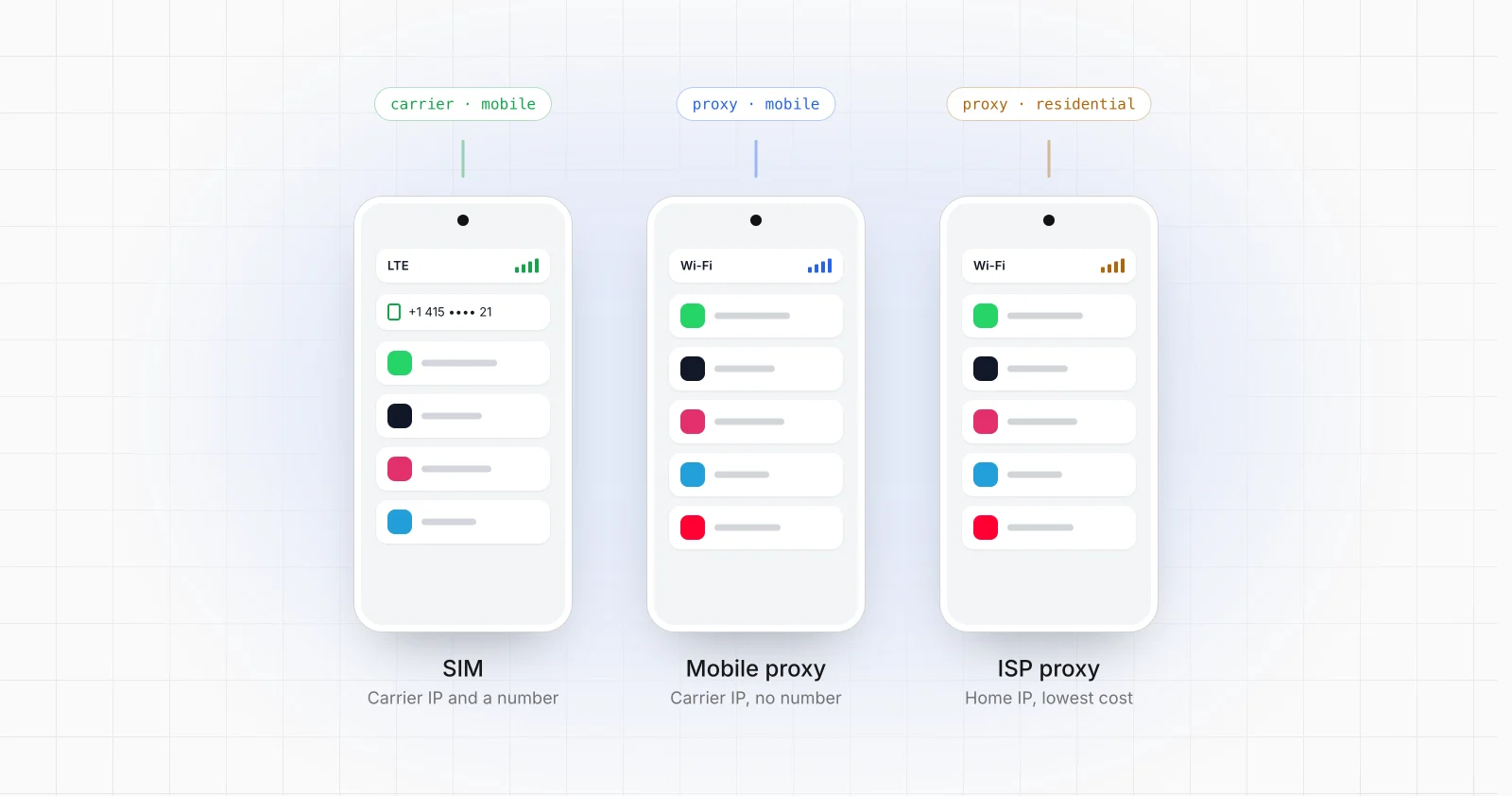
Every phone in a farm needs a way online, and how it gets there decides more than speed. The network is part of what an app sees about an account: which country it seems to be in, what kind of connection it is on, and whether it shares an address with a hundred other accounts. It is also, in most farms, the biggest monthly cost, ahead of the phones and ahead of any software.
The three common choices are a SIM in each phone, a mobile proxy per phone and a residential or ISP proxy per phone. This guide compares them, with list prices as of November 2026, and ends with which to pick for which job.
The options at a glance
| SIM in each phone | Mobile proxy | Residential / ISP proxy | |
|---|---|---|---|
| What the app sees | A mobile carrier connection | A mobile carrier IP | A home broadband IP |
| Comes with a phone number | Yes | No | No |
| Can receive SMS and calls | Yes | No | No |
| Typical cost per phone, per month | About $2 to $25, by country and data | About $25 to $46 for a dedicated IP | About $2 to $3.50 for a static IP |
| Works on cloud phones | Not physically | Yes | Yes |
| Main limit | Data caps, SIM registration rules | Price | Looks less like a phone |
Prices are list prices for single units and vary by country, provider and contract length. To see what they add up to for your farm, the phone farm cost calculator compares them across your own phones, box phones and cloud phones.
A SIM in each phone
A SIM gives each phone what a real person's phone has: a mobile data connection from a carrier and a phone number that can receive SMS and calls.
Why farms use it:
- The number. Apps that verify by SMS or call, WhatsApp above all, need a number to register. A proxy does not give you one.
- The connection looks like a phone's, because it is one. Carriers put many customers behind shared addresses, so mobile IPs are used by lots of ordinary people at once.
- Cost. Prepaid plans with SMS start at a few dollars or euros a month in many countries, and around $15 to $25 for plans with real data in the US.
What to watch:
- Data caps. Video apps use a lot of data. A plan that is fine for WhatsApp can run out in days on TikTok.
- SIM registration rules. Many countries require each SIM to be registered to a real person. Follow them; buying SIMs registered in other people's names is illegal in many places (see are phone farms legal?).
- Inactive numbers. Some prepaid numbers are deactivated after months without use, which can lock you out of the account registered to it.
- Hardware. Every phone needs a working SIM slot and signal. Box phone boards and cloud phones may not take a SIM at all.
A mobile proxy per phone
A mobile proxy routes the phone's app traffic through a modem or phone on a carrier network somewhere else, so the app sees a mobile IP even though the phone itself is on Wi-Fi.
Why farms use it:
- A mobile IP without a SIM in the phone, which is the only way to get one on cloud phones and on box phones without SIM slots.
- Location. You can pick the country, and often the carrier, independently of where the phones physically are.
- No data caps on many dedicated plans.
What to watch:
- Price. A dedicated mobile proxy with its own IP costs about $41 to $46 a month on monthly terms from mainstream providers, about $25 to $29 a month when paid for a year, and premium 5G ports cost several times more. Across a large farm this is often the single biggest line.
- No number. You still need SIMs or another source of numbers for apps that verify by SMS.
- Rotation. Many mobile proxies change IP on a timer or on request. An account whose address jumps around mid-session looks odd. Keep each account on one sticky IP, or rotate only between sessions.
- Sharing. Cheaper plans share one IP between several customers or devices. If ten of your accounts share it, they are linked through it.
A residential or ISP proxy per phone
Residential and ISP proxies give each phone an IP that belongs to a home broadband provider. Static ISP proxies keep the same IP for as long as you rent it.
Why farms use it:
- Cost. A static ISP IP costs around $2 to $3.50 a month, a fraction of a mobile proxy.
- Stability. One fixed address per account, every day, which is exactly what a person at home looks like.
What to watch:
- It is not a phone network. A phone that appears to be on home Wi-Fi all day is normal, so for many apps this is fine. For apps that weigh mobile traffic more, it carries more risk than a SIM or a mobile proxy.
- Rotating residential proxies, priced per gigabyte, are cheaper for light traffic but change address. They suit occasional checks better than accounts that stay logged in.
- Avoid datacenter proxies for accounts. Their addresses are well known to belong to servers, not people.
Rules that matter more than the choice
Whichever network you pick, a few habits do more for account health than the network type itself:
- One network identity per account. Do not let several accounts share one IP unless they belong together anyway. See how many accounts per phone.
- Keep it consistent. The same account on the same address, day after day. Sudden country changes look like a stolen account.
- Match the story. The IP's country should match the number, the language and the time zone the account uses.
- Separate the automation from the app traffic. If the software that drives the phone shares the proxy with the apps, a proxy hiccup can take the phone offline.
On MationX, the apps on each phone go through that phone's SOCKS5 proxy while the MationX Client itself stays on a direct connection, so a proxy that drops never cuts the phone off from the farm. The downloadable version of the client can also run a proxy tunnel per phone without root.
Which one to pick
- WhatsApp numbers: a SIM in each phone, or at least a SIM for registration. The number is not optional.
- TikTok and Instagram on your own phones: a SIM with enough data, or a mobile proxy if the phones are on Wi-Fi.
- Cloud phones or box phones without SIM slots: mobile proxies where the app weighs mobile traffic, static ISP proxies where cost matters more.
- Low-risk or internal accounts: static ISP proxies.
- Mixed farms: SIMs for the numbers, proxies for the traffic. Plenty of farms register with a SIM and then run the app over Wi-Fi through a proxy.
For the rest of what a farm needs, see phone farm setup and iPhone farm vs Android farm. If you already know your phones and apps, tell us about your farm and you get one number for the whole setup within a day.
Common questions
Do I need a SIM card in every phone of a phone farm? Only if the apps need a phone number or you want each phone on its own mobile connection. Many farms use SIMs for apps like WhatsApp and proxies for the rest.
Are mobile proxies better than residential proxies? For apps that weigh mobile traffic heavily, usually, because the IP comes from a carrier. They also cost roughly ten times more per IP, so many farms use them only where it matters.
Can several phones share one mobile proxy? They can, but the accounts on them are then linked through the shared address. For accounts that matter, give each phone its own IP.
Can cloud phones use a SIM? Not physically. Cloud phones get online through the provider's network and a proxy. Numbers for SMS verification have to come from somewhere else.